REACH Nexus
Resilience to Extreme weather: Advancing Climate-Health Nexus
Dutch–Brazilian collaboration developing climate adaptation for vulnerable groups using citizen science, systems modelling, and policy innovation.
Project at a glance
Project log
-
Kickoff: the first in-person meeting, and a walk through Jardim Pantanal
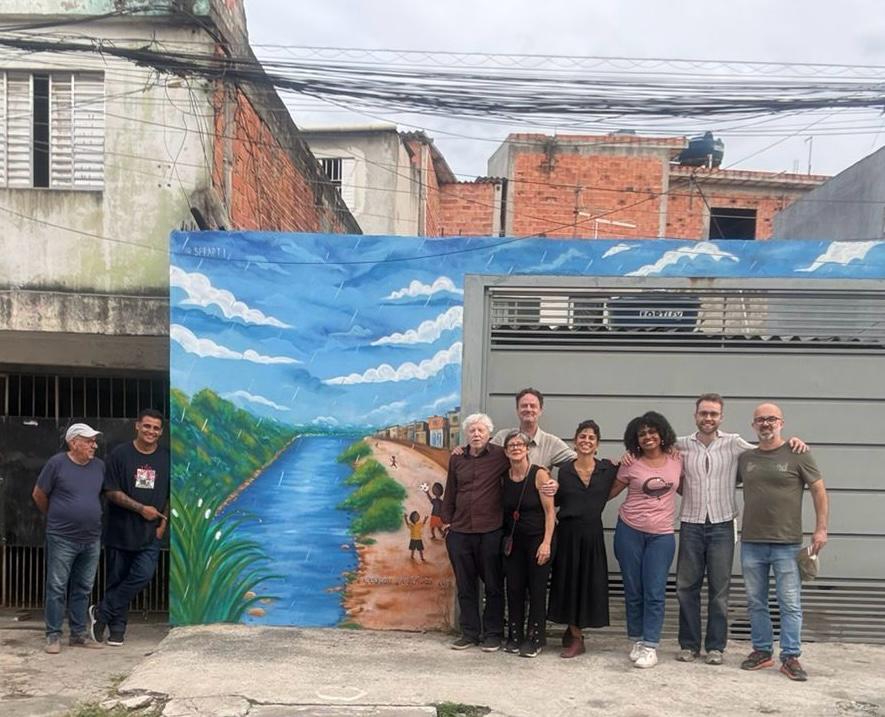
The Amsterdam and São Paulo sides of the consortium met in person for the first time at FAPESP, where the five Merian-funded projects had gathered for a three-day kickoff. The first two days belonged to the conference room. Each team introduced its work; the projects then sat down together to compare notes, ask questions, and look for the places where their plans overlap.
On the third day the meeting moved out of the conference room and into the field. Together with our local partner Instituto Alana, the Brazilian, Dutch and Alana teams walked Jardim Pantanal, the floodplain neighbourhood that is one of the project's case sites. Walking the place together gave the Dutch side a first real sense of where this work will live over the coming five years. A strong, memorable beginning, and a promising start to the project.
-
Project funded under the NWO–FAPESP Merian Fund call
REACH Nexus has been selected as one of five Brazilian–Dutch consortia funded under the NWO–FAPESP Cooperation Brazil–The Netherlands 2024 call "Extreme Heat and Water Events: Mitigating the Adverse Health Effects of Climate Change in Cities." The five-year programme begins on 1 May 2026 and is jointly led by Reinout Wiers (UvA) and Leandro Giatti (USP).
Why this project
Intensifying extreme weather events disproportionately impact marginalized populations, increasing existing health inequalities and vulnerabilities. This complex "polycrisis" is studied from a systems perspective. Four case studies are developed where experts and stakeholders collaboratively model vulnerabilities and identify feedback loops to find key intervention targets. Data collection follows, using a citizen-science approach to ensure that the models reflect local contexts and lived experiences. These models are refined over time, ultimately generating site-specific policy recommendations and a transferable modelling framework applicable to other vulnerable urban settings worldwide.
Where the work happens
Overview of four case studies.
Three phases over five years
Understand
Foundational analysis: baseline health-system capacity, climate exposure and historic vulnerability across the four sites, viewed through a climate-justice lens.
Integrate
Local working groups co-develop models that capture the interactions between urban planning, health policy and climate adaptation, fed by citizen-science data.
Improve
Translate findings into living-lab pilots in Brazil and the Netherlands, plus model-based policy advice for partner municipalities.